Generative Engine Optimization (GEO) Agency Washington DC
Gigawatt Group helps organizations improve how their expertise is discovered, retrieved, represented, mentioned, and cited across AI-assisted search. Our GEO programs connect technical SEO, non-brand search visibility, expert content, topic authority, source analysis, AI citation tracking, and conversion measurement into one operating system.
Evaluating an agency partner? Invite Gigawatt Group to your GEO or AI search RFP →
What is GEO? Generative Engine Optimization is the practice of improving the controllable factors that support visibility in AI-assisted search, including technical accessibility, traditional search performance, useful expert content, topic coverage, entity clarity, authoritative source presence, citation readiness, and measurement. GEO cannot guarantee that an independent AI platform will cite or recommend a brand.
Build Content Worth Retrieving, Citing & Exploring
AI-search visibility begins with content that is useful in ordinary search and valuable enough to support a complex answer. Gigawatt Group develops content systems around real buyer questions, original expertise, evidence, comparisons, case studies, definitions, technical detail, and related topics so search and AI-assisted discovery have substantive material to retrieve.
AI Search Changes the Discovery Journey, Not the Need for Strong SEO
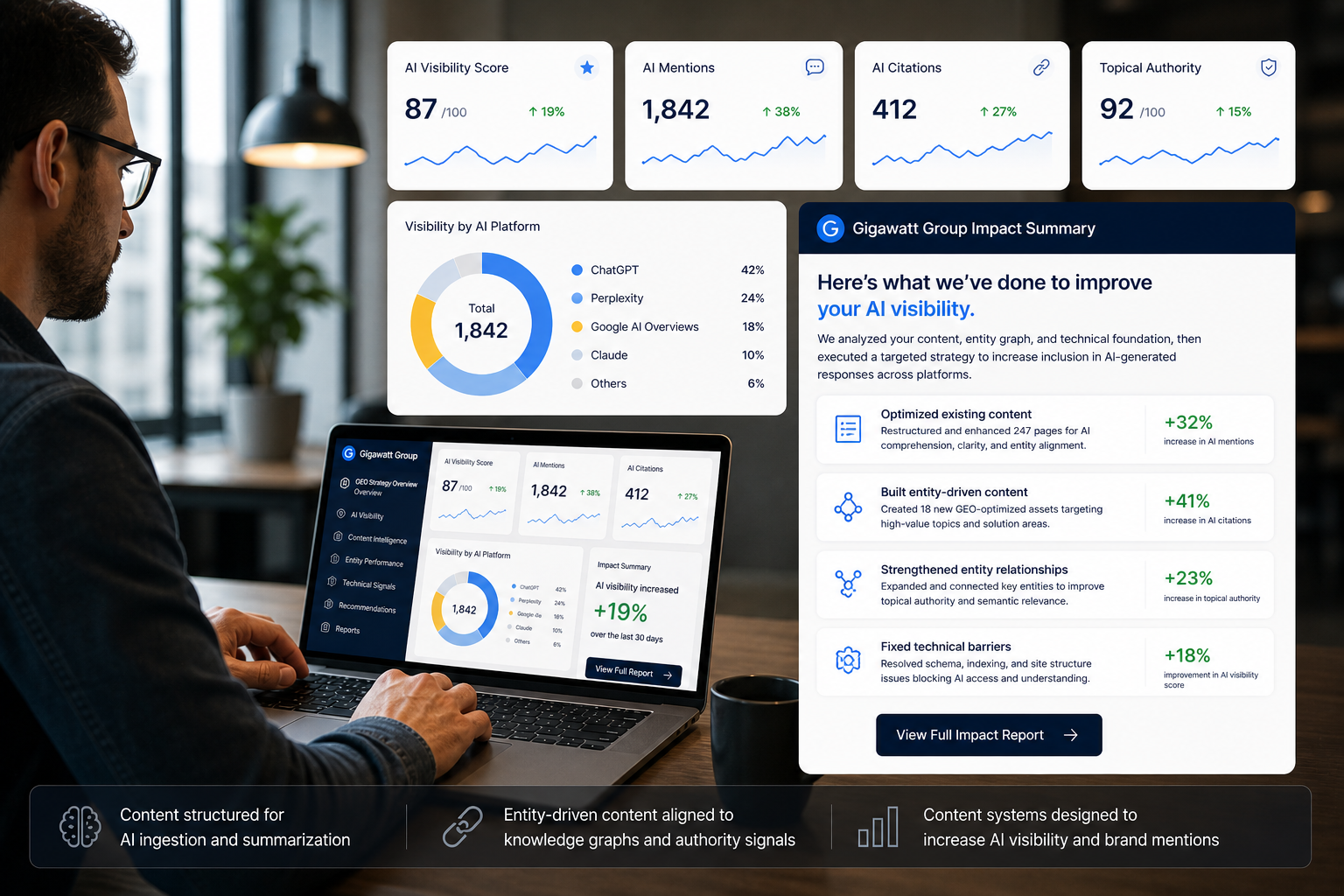
Buyers can now use AI-assisted search to investigate a category, ask follow-up questions, compare approaches, identify providers, and explore supporting sources within the same research workflow. That creates more opportunities for useful, authoritative pages to enter the consideration process before a buyer reaches a vendor website directly.
GEO gives marketing and communications teams a disciplined way to evaluate that new discovery environment while strengthening the technical SEO, original content, source authority, and measurement systems that already support organic visibility.
AI Search Expands the Query Set
A single complex question can generate multiple related searches and subtopics. Strong topic coverage creates more opportunities for relevant pages to support those research paths.
Search Remains a Retrieval Foundation
Technical accessibility, indexing, internal links, useful content, and traditional organic visibility remain foundational to participation in AI-powered Google Search experiences.
Citations Reveal the Source Ecosystem
Tracking which domains and pages are cited across priority questions can show which owned, earned, industry, editorial, or reference sources influence the answers buyers see.
Original Evidence Creates Differentiation
Research, client findings, expert commentary, methodologies, case studies, and proprietary data give search and AI systems information that cannot be reproduced by simply summarizing existing webpages.
Visibility and Citation Are Different Outcomes
Rankings, mentions, citations, referral traffic, and business impact should be measured separately. A stronger GEO program makes those distinctions visible to leadership.
Independent Platforms Control the Result
No agency can guarantee an AI citation or recommendation. Effective GEO improves controllable inputs, observes outputs over time, and continuously tests where the organization can earn greater visibility.
From AI Visibility Baseline to Citation & Business Impact
Gigawatt Group treats GEO as a measurable operating discipline. We establish the questions and topics that matter, determine where the organization is visible today, improve the search and content foundation, analyze the sources influencing AI answers, publish evidence-led content, and then measure changes across citations, mentions, search visibility, referrals, and business outcomes.
Query, Prompt & Competitor Baseline
Establish a controlled portfolio of priority commercial questions, buyer problems, category prompts, competitors, and target topics. Record where the brand appears, how it is described, which sources are cited, and where visibility is absent.
Technical Search & Crawler Access
Audit indexing, crawlability, rendering, internal architecture, canonicalization, page experience, robots directives, structured data, and access for relevant search crawlers so valuable content can actually be discovered.
Topic, Entity & Source Analysis
Map the topics the organization should credibly own, the evidence needed to support those claims, the pages already earning visibility, and the external sources that repeatedly influence answers across the query portfolio.
Evidence-Led Content Development
Improve priority service pages and publish expert-led resources, original research, case studies, comparisons, definitions, methodologies, data, and executive perspectives that add unique information to the category.
Authority & Citation Development
Strengthen internal relationships between relevant pages, support credible third-party visibility, improve source coverage, and address citation gaps where the organization has legitimate expertise and evidence to contribute.
AI Visibility & Business Measurement
Re-test the controlled portfolio and report citations, mentions, competitive visibility, source patterns, non-brand search growth, referrals, conversions, and other outcome measures separately so leadership can see what changed.
Technical accessibility is part of GEO
GEO implementation should verify that important content is accessible to traditional search crawlers and, where appropriate, AI-search crawlers. This includes reviewing robots.txt, indexing controls, rendering, internal links, canonical URLs, and whether the organization's policies allow crawlers used by the platforms it wants visibility from.
Expanding Discovery Across Search & AI-Generated Answers
CTS is a nationwide provider of carrier-grade in-building wireless infrastructure and managed connectivity services. Gigawatt Group built an integrated SEO and GEO program to help more prospective buyers discover CTS while researching connectivity challenges, technical requirements, private wireless solutions, and related business needs.
The strategy expanded CTS beyond branded searches and into the broader questions buyers ask across Google Search, AI Overviews, and AI-assisted discovery. Content, technical SEO, topic coverage, internal architecture, and authority development worked together to increase the number of relevant pathways that could lead a buyer to CTS.
- 138,602
- Clean non-brand discovery impressions
- 919
- Non-brand queries creating discovery opportunities
- +12.38
- Weighted average position improvement
Weighted average position improved from 30.35 to 17.97, giving CTS stronger visibility across a substantially broader set of non-brand searches. The same content and authority system increased the company's readiness to surface within Google AI Overviews and other AI-generated answers when buyers researched the problems and solutions CTS is positioned to address.
CTS client performance, December 2025 through June 2026
Measure the AI Search Environment, Then Improve the Inputs You Control
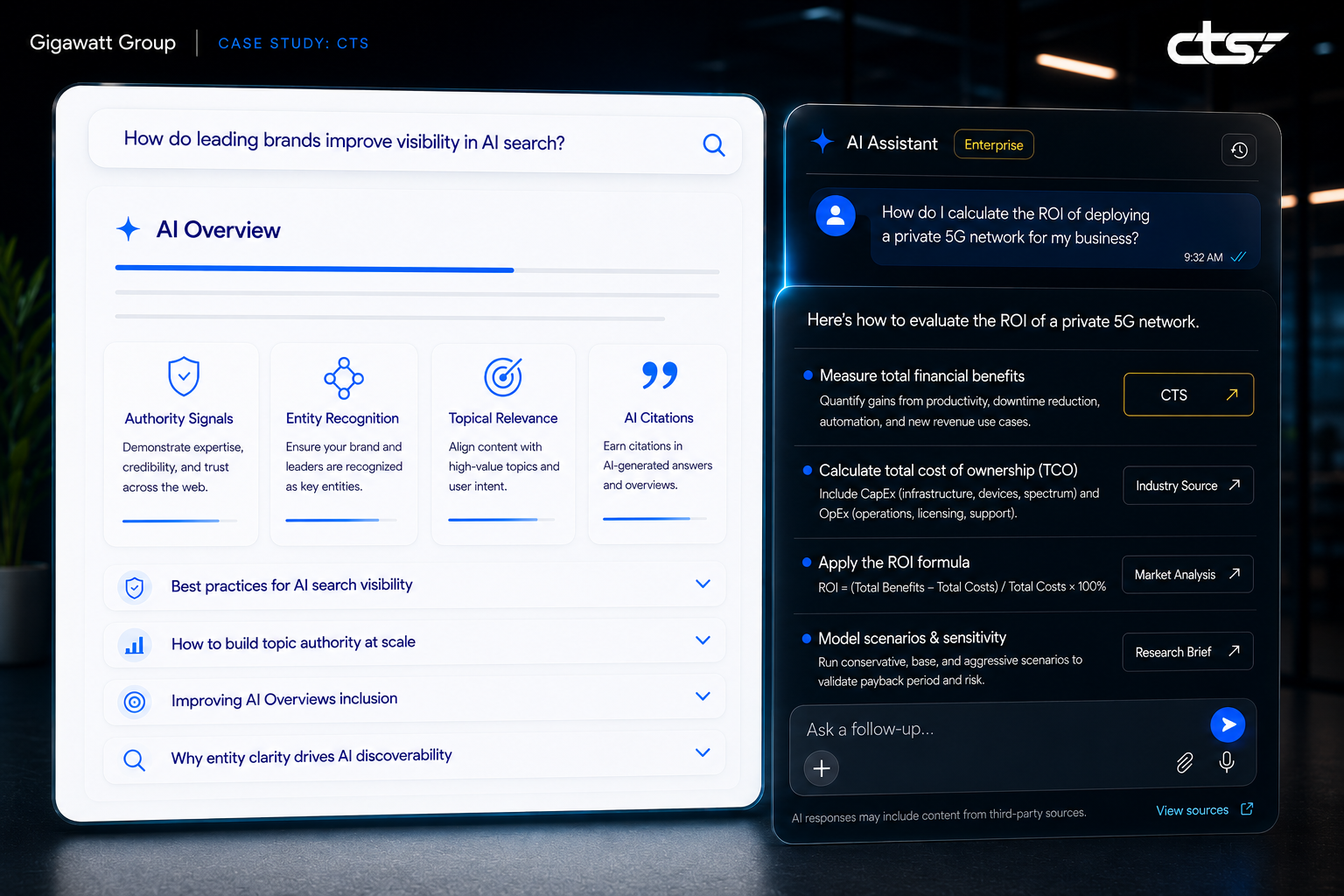
Enterprise GEO requires more than publishing additional content. Gigawatt Group combines visibility measurement, technical search infrastructure, source intelligence, expert content, and digital marketing execution so teams can understand where they appear today and make informed decisions about what to improve next.
AI Citation & Mention Analytics
Monitor priority prompt portfolios across relevant AI-search environments to track brand mentions, citations, competitive presence, source patterns, answer changes, and topic-level share of visibility.
Technical & Entity Architecture
Improve crawlability, indexing, semantic page relationships, internal linking, canonicalization, structured data where appropriate, and consistent representation of the organization's services, expertise, people, and topics.
Source & Authority Strategy
Analyze the domains that repeatedly support priority answers, identify owned-content and third-party source gaps, and develop evidence, thought leadership, research, case studies, and communications that strengthen legitimate category authority.
Build a More Defensible AI Search Visibility Program
Use these resources to evaluate GEO agencies, understand topic authority, develop answer-ready content, and determine which AI-search metrics belong in an enterprise reporting system.
How to Evaluate a Generative Engine Optimization Company
Compare GEO partners across diagnostics, technical competence, content execution, authority strategy, measurement, workflow integration, and commercial clarity.
Evaluate GEO agencies → TOPIC AUTHORITYHow Brands Build AI Topic Authority
Learn why topic-level visibility, evidence, independent corroboration, technical SEO, and separate measurement of mentions and citations matter.
Explore AI topic authority → ANSWER VISIBILITYAnswer Engine Optimization Services
Improve content around direct questions, answer-oriented search experiences, structured explanations, and measurable answer visibility.
Explore AEO services → CONTENT IMPLEMENTATIONGEO Content Strategy Services
Turn search and AI visibility findings into expert-led content systems, supporting pages, thought leadership, and ongoing optimization.
Explore GEO content strategy →GEO Services for Enterprise AI Search Visibility
Gigawatt Group combines diagnostic research, technical SEO, AI visibility measurement, content strategy, expert publishing, citation analysis, source intelligence, and performance reporting to help organizations compete more effectively across traditional search and AI-assisted discovery.
Generative Engine Optimization Agency FAQ
What is Generative Engine Optimization (GEO)?
Generative Engine Optimization is the practice of improving the controllable factors that support visibility in AI-assisted search. Those factors can include technical SEO, crawlability, non-brand search visibility, topic coverage, expert content, original evidence, entity clarity, source authority, internal linking, citation readiness, and measurement of mentions and citations.
What does a GEO agency do?
A GEO agency establishes an AI visibility baseline, researches priority queries and prompts, audits technical search foundations, analyzes competitors and citation sources, improves content and topic coverage, develops authority assets, monitors AI mentions and citations, and connects those changes to search and business performance.
How is GEO different from SEO?
SEO focuses on improving visibility and performance in search engines through technical optimization, content, authority, and user experience. GEO uses that foundation while adding AI-specific measurement such as prompt portfolios, brand mentions, citation frequency, source analysis, answer representation, and visibility across AI-assisted research journeys. Strong GEO does not replace SEO.
How is GEO different from Answer Engine Optimization (AEO)?
AEO focuses more narrowly on making content useful for direct questions and answer-oriented search experiences. GEO addresses the broader AI-search environment, including topic visibility, citations, source influence, brand representation, competitive presence, technical SEO, content authority, and measurement across generative discovery.
Does structured data improve AI citations?
Structured data can help search engines understand eligible page information and remains useful as part of technical SEO, but it is not a special GEO shortcut and does not guarantee inclusion in AI-generated answers. Structured data should accurately represent content that is visible on the page.
How can a website become eligible to appear in ChatGPT Search?
OpenAI recommends allowing OAI-SearchBot to access public website content that publishers want eligible to appear in ChatGPT Search. Crawl access alone does not guarantee that a page will be surfaced or cited, so content quality, relevance, discoverability, and the broader source environment still matter.
How should AI search visibility be measured?
Measurement should separate traditional search performance, AI mentions, citations, source inclusion, prompt coverage, competitive visibility, referral traffic, conversions, and downstream business impact. Gigawatt Group uses controlled query and prompt portfolios so changes can be compared consistently over time.
Can a GEO agency guarantee AI citations?
No. Independent search and AI platforms control their rankings, answers, citations, mentions, and recommendations. A GEO agency can improve controllable inputs, identify source and content opportunities, measure observable outcomes, and continually refine strategy based on what changes.
Our Generative Engine Optimization & AI Search Capabilities
Gigawatt Group combines traditional search expertise with AI visibility research, expert content, source intelligence, citation measurement, and business reporting so enterprise teams can manage AI-assisted discovery as part of a broader search and content strategy.
Research & Baseline
- AI visibility audits
- Prompt and query portfolio design
- Competitive AI visibility analysis
- Citation and source mapping
- Topic opportunity analysis
Technical SEO & Architecture
- Crawlability and indexing audits
- Googlebot and AI-search crawler review
- Site architecture and internal linking
- Entity and semantic page relationships
- Structured data implementation where appropriate
Content & Authority
- Expert-led GEO content strategy
- Original research and evidence assets
- Service-page and topic-cluster optimization
- Executive thought leadership
- AEO and answer-oriented content
Measurement & Optimization
- AI citation and mention tracking
- Source and competitive presence analysis
- Non-brand search visibility reporting
- ChatGPT and AI referral analysis
- Executive dashboards and ongoing testing